 Graphics by AJP Song Ji-yoonSEOUL, January 07 (AJP) - The number of criminal suspects who fled overseas after committing crimes in South Korea has surged past 1,000 for the first time on record, raising concerns that the country is increasingly exposed to transnational crime networks operating across Asia and Russia.
 According to the Korean National Police Agency (KNPA), 1,249 new overseas fugitives were recorded last year, up 31 percent from 951 a year earlier. It marked the first time the annual figure exceeded 1,000 since police began compiling the data.
Police attribute the sharp rise to the growing internationalization and organization of crime, particularly scam- and fraud-related offenses structured to operate across borders.
In the past, overseas flight was largely associated with suspects attempting to evade punishment after committing violent crimes such as murder or robbery. In recent years, however, many criminal operations have been designed from the outset to run from abroad, with perpetrators establishing overseas bases while targeting victims in South Korea.
That shift has drawn renewed attention to Cambodia, which has emerged as a major hub for global online scam operations. Last August, a South Korean college student who traveled to Cambodia after being promised a high-paying job was found dead near a crime compound in the Bokor Mountain area of Kampot province. A joint investigation and autopsy conducted with local authorities found extensive signs of assault and torture.
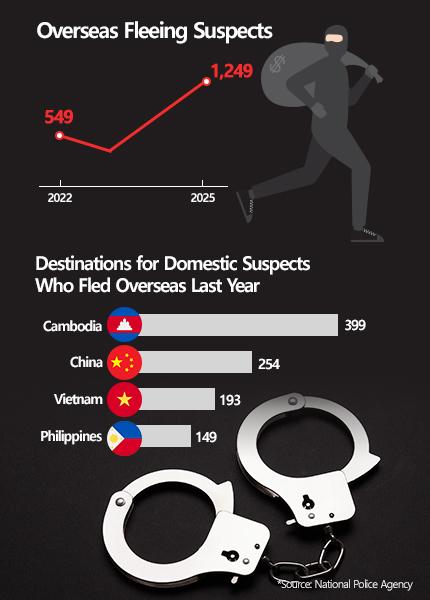 Graphics by AJP Song Ji-yoonCambodia has long been identified as a center for online scam activity involving the abduction and trafficking of foreign nationals. KNPA data show that Cambodia ranked first among destinations linked to overseas fugitives last year, with 399 suspects, or 31.8 percent of the total — overtaking China, which recorded 254 cases. The Cambodia-linked figure more than tripled from 123 a year earlier.
 Police believe hundreds of scam compounds operated by Chinese criminal organizations are scattered across Cambodia, drawing in criminal groups from South Korea, Japan, Vietnam and elsewhere to form an extensive transnational network.
Experts trace the roots of this structure to the mid-2000s, when Cambodia and China jointly developed the Sihanoukville Special Economic Zone. After China intensified its anti-corruption campaign under President Xi Jinping in 2018, casino capital and criminal groups relocated to Cambodia. When the COVID-19 pandemic undermined the casino economy, these groups pivoted to online scams, repurposing existing infrastructure and manpower into what police describe as corporate-style fraud operations.
Fraud accounted for the largest share of offenses among overseas fugitives last year, with 757 cases, or 60.6 percent of the total, followed by online gambling at 141 cases, or 11.3 percent. Most involved cyber-enabled financial crimes, including voice phishing, investment scams, romance scams and schemes using deepfake technology, the KNPA said.
"In the past, suspects could simply flee overseas and wait out the statute of limitations," said Shin Yi-chul, chair of the Department of Police Science at Wonkwang Digital University. "But the law has since been revised so that the statute of limitations is suspended when a suspect flees abroad. Overseas flight no longer offers a real escape — at best, it buys time."
Law enforcement authorities have stepped up cooperation with foreign counterparts through permanent joint investigation teams, enabling faster arrests on the ground.
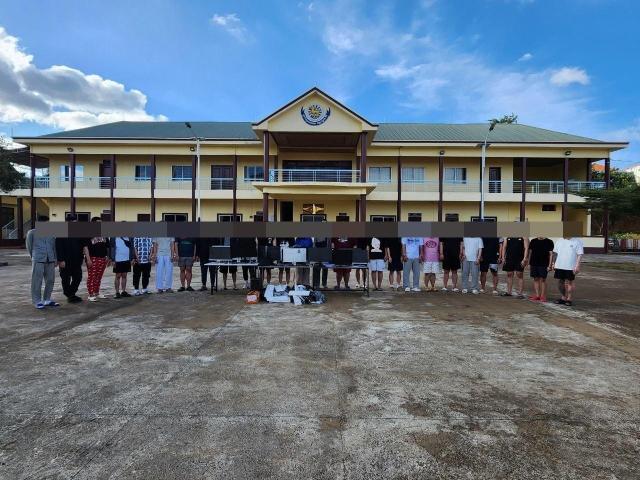 South Korean nationals accused of voice phishing and romance scam crimes arrested in Cambodia on Dec. 18, 2025. Courtesy of the Korean National Police AgencyA key example is the Korea Task Force jointly operated by South Korean and Cambodian police. Established in November, the unit arrested 92 South Korean suspects within its first month. In early December, authorities detained the ringleader and 15 members of a romance-scam organization responsible for 26 billion won ($1.8 million) in losses in Poipet. Later that month, joint raids near the Cambodia–Vietnam border led to the arrest of 26 additional suspects.
 Extraditions have also risen. Police repatriated 828 fugitives last year, up nearly 20 percent from the previous year, marking the fourth consecutive annual record since 2022. In total, 263 South Korean suspects were arrested in Cambodia alone.
"Crimes committed domestically have become much harder to carry out," an official at the KNPA's International Cooperation Bureau said. "International cooperation — through channels such as Interpol and bilateral partnerships — is now far more active and effective than in the past."
Kim Hee-su Reporter khs@ajupress.com

![[포토] 폭설에 밤 늦게까지 도로 마비](https://image.ajunews.com/content/image/2025/12/05/20251205000920610800.jpg)

![[포토] 예지원, 전통과 현대가 공존한 화보 공개](https://image.ajunews.com/content/image/2025/10/09/20251009182431778689.jpg)

![[포토]두산 안재석, 관중석 들썩이게 한 끝내기 2루타](https://file.sportsseoul.com/news/cms/2025/08/28/news-p.v1.20250828.1a1c4d0be7434f6b80434dced03368c0_P1.jpg)
![블랙핑크 제니, 매력이 넘쳐! [포토]](https://file.sportsseoul.com/news/cms/2025/09/05/news-p.v1.20250905.c5a971a36b494f9fb24aea8cccf6816f_P1.jpg)
![[작아진 호랑이③] 9위 추락 시 KBO 최초…승리의 여신 떠난 자리, KIA를 덮친 '우승 징크스'](http://www.sportsworldi.com/content/image/2025/09/04/20250904518238.jpg)
![블랙핑크 제니, 최강매력! [포토]](https://file.sportsseoul.com/news/cms/2025/09/05/news-p.v1.20250905.ed1b2684d2d64e359332640e38dac841_P1.jpg)
![[포토]첫 타석부터 안타 치는 LG 문성주](https://file.sportsseoul.com/news/cms/2025/09/02/news-p.v1.20250902.8962276ed11c468c90062ee85072fa38_P1.jpg)
![[포토] 국회 예결위 참석하는 김민석 총리](https://cphoto.asiae.co.kr/listimg_link.php?idx=2&no=2025110710410898931_1762479667.jpg)
![[포토] 발표하는 김정수 삼양식품 부회장](https://image.ajunews.com/content/image/2025/11/03/20251103114206916880.jpg)
![[포토] 박지현 '아름다운 미모'](http://www.segye.com/content/image/2025/11/19/20251119519369.jpg)
![[포토] 김고은 '단발 여신'](http://www.segye.com/content/image/2025/09/05/20250905507236.jpg)

![[포토] 키스오브라이프 하늘 '완벽한 미모'](http://www.segye.com/content/image/2025/09/05/20250905504457.jpg)
![[포토] 알리익스프레스, 광군제 앞두고 팝업스토어 오픈](https://cphoto.asiae.co.kr/listimg_link.php?idx=2&no=2025110714160199219_1762492560.jpg)
![[포토] '삼양1963 런칭 쇼케이스'](https://image.ajunews.com/content/image/2025/11/03/20251103114008977281.jpg)
![[포토] 언론 현업단체, "시민피해구제 확대 찬성, 권력감시 약화 반대"](https://image.ajunews.com/content/image/2025/09/05/20250905123135571578.jpg)

![[포토] 박지현 '순백의 여신'](http://www.segye.com/content/image/2025/09/05/20250905507414.jpg)

![[포토] 김고은 '상연 생각에 눈물이 흘러'](http://www.segye.com/content/image/2025/09/05/20250905507613.jpg)
![[포토]끝내기 안타의 기쁨을 만끽하는 두산 안재석](https://file.sportsseoul.com/news/cms/2025/08/28/news-p.v1.20250828.0df70b9fa54d4610990f1b34c08c6a63_P1.jpg)
![[포토] 한샘, '플래그십 부산센텀' 리뉴얼 오픈](https://image.ajunews.com/content/image/2025/10/31/20251031142544910604.jpg)
![[포토] 아이들 소연 '매력적인 눈빛'](http://www.segye.com/content/image/2025/09/12/20250912508492.jpg)

![[포토]두산 안재석, 연장 승부를 끝내는 2루타](https://file.sportsseoul.com/news/cms/2025/08/28/news-p.v1.20250828.b12bc405ed464d9db2c3d324c2491a1d_P1.jpg)
![[포토] 키스오브라이프 쥴리 '단발 여신'](http://www.segye.com/content/image/2025/09/05/20250905504358.jpg)
![[포토] 아홉 '신나는 컴백 무대'](http://www.segye.com/content/image/2025/11/04/20251104514134.jpg)