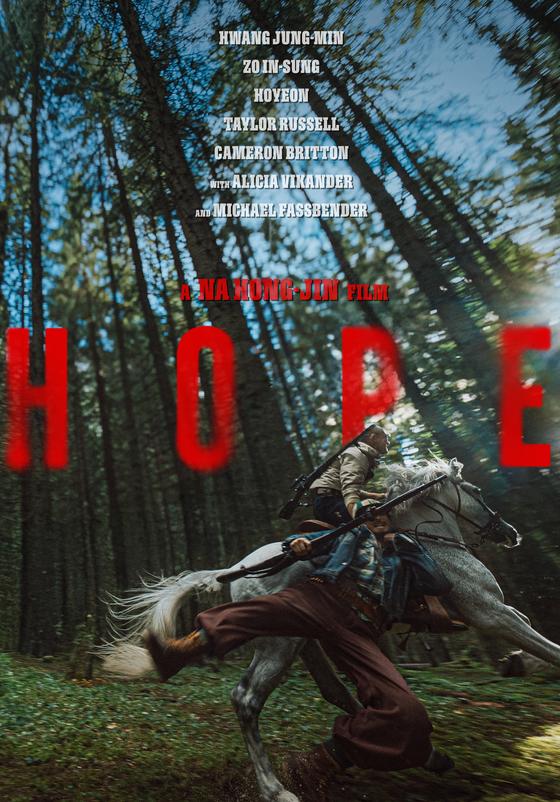
 Director Na Hong-jin's new film 'Hope'. Courtesy of Plus M EntertainmentSEOUL, January 12 (AJP) - After a year that many in the industry would rather forget, Korean cinema is lining up a high-stakes reset for 2026.
 The drought of 2025 was historic for all the wrong reasons. For the first time since 2012—excluding the pandemic years—not a single film crossed the 10-million-admissions mark.
Even the symbolic 5 million barrier proved elusive. Big names stumbled, audience momentum stalled, and production volumes fell to nearly half their pre-COVID levels. The message was clear: the old formulas no longer guaranteed survival.
Now comes the counteroffensive.
 "Director Na Hong-jin's 'Hope'-related drawing posted on his Instagram account on Mar. 29, 2023. source- Na Hong-jin's InstagramLeading the charge is Na Hong-jin’s Hope, reportedly the most expensive Korean film ever made, with a production budget exceeding 70 billion won. Set for release in July and aiming for a Cannes premiere, Hope marks Na’s return after a decade, following The Wailing (2016). True to form, the director moves away from genre comfort zones, staging a mysterious extraterrestrial encounter in a fictional village near the DMZ. The cast—Zo In-sung, Hwang Jung-min, Jung Ho-yeon, Michael Fassbender and Alicia Vikander—signals ambition well beyond the domestic market.
 Zo In-sung alone embodies the year’s pipeline logic. He will also headline Ryoo Seung-wan’s Humint, a South–North espionage thriller set in Vladivostok and slated for the 2026 Lunar New Year season. Shot in Latvia, the film leans into scale, geopolitics and genre clarity—exactly the elements Korean distributors are betting can still pull audiences back to theaters.
 The director and cast posing at the Humint production press conference held in Seoul on Jan. 12, 2026. Zo In-sung is on the far left. YonhapOn another front, Yeon Sang-ho returns to zombies with Colony, a high-concept survival thriller about an apartment complex sealed off by a mutating virus. Promoted as his most commercial work since Train to Busan, the film also marks Jun Ji-hyun’s first big-screen appearance in 11 years. Where Train to Busan thrived on kinetic panic, Colony promises something colder and more systemic: infected minds forming networks, not mobs.
 Then there is Lee Chang-dong, whose long-awaited new film Possible Love takes a different route entirely. Instead of theaters, the Cannes- and Venice-honored director has gone straight to Netflix.
The decision, born partly of funding difficulties, has become emblematic of the industry’s fault line: auteurs still command global prestige, but no longer automatic domestic investment. Written with longtime collaborator Oh Jung-mi, the film reunites Lee with actors who define modern Korean cinema: Sol Kyung-gu, Jeon Do-yeon, Cho Yeo-jeong and Zo In-sung.
What ties these projects together is not optimism, but necessity. With only 22 Korean films scheduled by the five major distributors in 2026—down from roughly 40 before the pandemic—every release carries disproportionate weight. The industry is no longer flooding the market; it is concentrating its bets.
The stakes are clear. Since The Roundup: Punishment crossed 10 million admissions in April 2024, no Korean film has followed. The symbolic era that began with Silmido and peaked with The Host and The Admiral: Roaring Currents now feels distant. What replaces it remains uncertain.
Yet 2026 suggests a pivot rather than a retreat: fewer films, higher budgets, sharper genre positioning—and, increasingly, a split path between theatrical spectacle and stream-first prestige.
After the silence of 2025, Korean cinema is speaking again.
The question is whether audiences are ready to listen.
Lee Jung-woo Reporter cannes2030@ajupress.com

![[포토] 폭설에 밤 늦게까지 도로 마비](https://image.ajunews.com/content/image/2025/12/05/20251205000920610800.jpg)

![[포토] 국회 예결위 참석하는 김민석 총리](https://cphoto.asiae.co.kr/listimg_link.php?idx=2&no=2025110710410898931_1762479667.jpg)
![[포토] 알리익스프레스, 광군제 앞두고 팝업스토어 오픈](https://cphoto.asiae.co.kr/listimg_link.php?idx=2&no=2025110714160199219_1762492560.jpg)
![[포토] 예지원, 전통과 현대가 공존한 화보 공개](https://image.ajunews.com/content/image/2025/10/09/20251009182431778689.jpg)


![[포토]두산 안재석, 관중석 들썩이게 한 끝내기 2루타](https://file.sportsseoul.com/news/cms/2025/08/28/news-p.v1.20250828.1a1c4d0be7434f6b80434dced03368c0_P1.jpg)
![[작아진 호랑이③] 9위 추락 시 KBO 최초…승리의 여신 떠난 자리, KIA를 덮친 '우승 징크스'](http://www.sportsworldi.com/content/image/2025/09/04/20250904518238.jpg)
![블랙핑크 제니, 최강매력! [포토]](https://file.sportsseoul.com/news/cms/2025/09/05/news-p.v1.20250905.ed1b2684d2d64e359332640e38dac841_P1.jpg)
![[포토]첫 타석부터 안타 치는 LG 문성주](https://file.sportsseoul.com/news/cms/2025/09/02/news-p.v1.20250902.8962276ed11c468c90062ee85072fa38_P1.jpg)
![[포토] 아홉 '신나는 컴백 무대'](http://www.segye.com/content/image/2025/11/04/20251104514134.jpg)
![블랙핑크 제니, 매력이 넘쳐! [포토]](https://file.sportsseoul.com/news/cms/2025/09/05/news-p.v1.20250905.c5a971a36b494f9fb24aea8cccf6816f_P1.jpg)
![[포토] 키스오브라이프 하늘 '완벽한 미모'](http://www.segye.com/content/image/2025/09/05/20250905504457.jpg)
![[포토] 박지현 '아름다운 미모'](http://www.segye.com/content/image/2025/11/19/20251119519369.jpg)

![[포토] 박지현 '순백의 여신'](http://www.segye.com/content/image/2025/09/05/20250905507414.jpg)
![[포토] 김고은 '단발 여신'](http://www.segye.com/content/image/2025/09/05/20250905507236.jpg)
![[포토] 발표하는 김정수 삼양식품 부회장](https://image.ajunews.com/content/image/2025/11/03/20251103114206916880.jpg)
![[포토] 언론 현업단체, "시민피해구제 확대 찬성, 권력감시 약화 반대"](https://image.ajunews.com/content/image/2025/09/05/20250905123135571578.jpg)
![[포토] '삼양1963 런칭 쇼케이스'](https://image.ajunews.com/content/image/2025/11/03/20251103114008977281.jpg)
![[포토]끝내기 안타의 기쁨을 만끽하는 두산 안재석](https://file.sportsseoul.com/news/cms/2025/08/28/news-p.v1.20250828.0df70b9fa54d4610990f1b34c08c6a63_P1.jpg)
![[포토] 한샘, '플래그십 부산센텀' 리뉴얼 오픈](https://image.ajunews.com/content/image/2025/10/31/20251031142544910604.jpg)
![[포토] 김고은 '상연 생각에 눈물이 흘러'](http://www.segye.com/content/image/2025/09/05/20250905507613.jpg)

![[포토] 아이들 소연 '매력적인 눈빛'](http://www.segye.com/content/image/2025/09/12/20250912508492.jpg)
![[포토]두산 안재석, 연장 승부를 끝내는 2루타](https://file.sportsseoul.com/news/cms/2025/08/28/news-p.v1.20250828.b12bc405ed464d9db2c3d324c2491a1d_P1.jpg)
![[포토] 키스오브라이프 쥴리 '단발 여신'](http://www.segye.com/content/image/2025/09/05/20250905504358.jpg)